Horse Chestnut
Not listed does not mean safe.
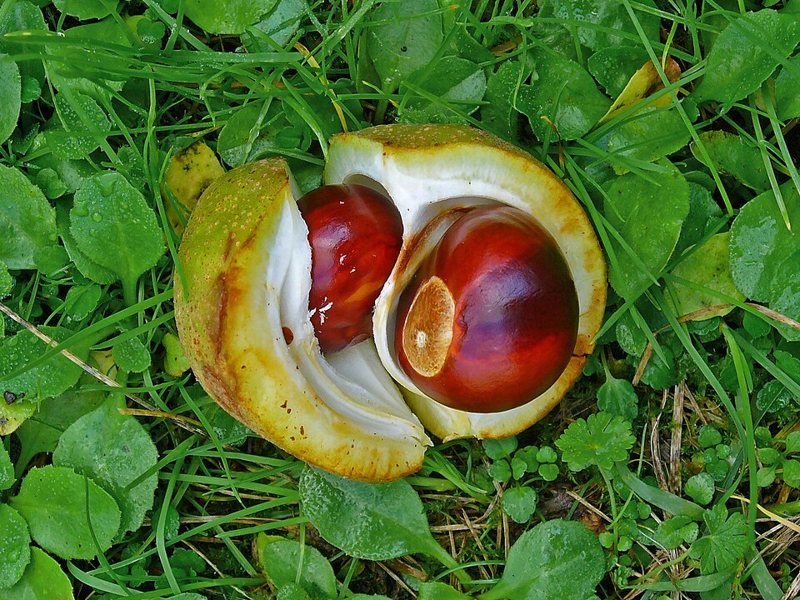
H. Zell · CC BY-SA 3.0 · Photo source · shows: Aesculus glabra

Aesculus glabra
Also known as: Buckeye, Ohio Buckeye, Fetid Buckeye
Family: Sapindaceae · ASPCA plant record
Verdict at a glance
Show all animals
Evidence by animal
| Animal | Verdict | Basis | Plant parts | Sources | Evidence link |
|---|---|---|---|---|---|
| Companion mammals | |||||
| Cats | Cats: ⚠ Toxic | Not specified | ASPCA Toxic and Non-Toxic Plants Poison control | evidence | |
| Dogs | Dogs: ⚠ Toxic | Not specified | ASPCA Toxic and Non-Toxic Plants Poison control | evidence | |
| Horses & livestock | |||||
| Horses | Horses: ⚠ Toxic | Not specified | ASPCA Toxic and Non-Toxic Plants Poison control | evidence | |
| Goats | Goats: ! Caution | Cornell: genus-level listing | fruit | Cornell University University | evidence |
| Chickens & other poultry | Chickens & other poultry: ⇄ Conflicting sources Sources disagree — we show both, not a verdict. | Aesculus hippocastanum seed extract: LD50 10.6 mg/g in chicks (PMID 6538769); Aesculus glabra (Ohio buckeye) seed extract: nontoxic to chicks at 80 mg/g (PMID 6538769) | seeds (extract) | evidence | |
| Small mammals | |||||
| Hamsters | Hamsters: ⇄ Conflicting sources Sources disagree — we show both, not a verdict. | Aesculus hippocastanum seed extract: LD50 10.7 mg/g (PMID 6538769); Aesculus glabra (Ohio buckeye) seed extract: nontoxic at 80 mg/g (PMID 6538769); Yellow buckeye (A. octandra) extract: 1 of 5 hamsters died (PMID 6538769) | seeds (extract) | evidence | |
| Reptiles | |||||
| Tortoises | Tortoises: ! Caution | Tortoise Trust: listed as toxic, degree uncertain | Not specified | Tortoise Trust Specialist charity | evidence |
Source excerpts
ASPCA Toxic and Non-Toxic Plants — Cats, Dogs, Horses
poison-control
Toxic to Dogs, Toxic to Cats, Toxic to Horses
Source checked 2026-10-27
Read original sourceToxicity of seeds of three Aesculus spp to chicks and hamsters — Hamsters, Chickens & other poultry
peer-reviewed
Aesculus hippocastanum seed extract: LD50 10.7 mg/g (PMID 6538769) · seeds (extract) · Tested species was Aesculus hippocastanum (horse chestnut) in adult female Syrian hamsters. The ASPCA page for this entry names Aesculus glabra, which the same paper tested separately (next result). Species results conflict, so the status is a conflict, not a verdict.
Aesculus hippocastanum seed extract: LD50 10.6 mg/g in chicks (PMID 6538769) · seeds (extract) · Tested on 2-week-old Leghorn chicks with Aesculus hippocastanum (horse chestnut). The ASPCA entry names Aesculus glabra, tested separately in the same paper (next result).
The LD50 for a single dose of extract from horse-chestnut seeds was 10.6 mg/g of body weight for chicks and 10.7 mg/g of body weight for hamsters.
Source checked 2026-10-27
Read original sourceToxicity of seeds of three Aesculus spp to chicks and hamsters — Hamsters, Chickens & other poultry
peer-reviewed
Aesculus glabra (Ohio buckeye) seed extract: nontoxic at 80 mg/g (PMID 6538769) · seeds (extract) · Ohio buckeye is Aesculus glabra, the species named by the ASPCA entry. Result is for an extract fed to adult female Syrian hamsters at 80 mg/g; it is not a statement about other doses, plant parts or animals.
Aesculus glabra (Ohio buckeye) seed extract: nontoxic to chicks at 80 mg/g (PMID 6538769) · seeds (extract) · Ohio buckeye is Aesculus glabra, the species named by the ASPCA entry. Result is for an extract fed to 2-week-old Leghorn chicks at 80 mg/g.
Extracts of seeds of Ohio buckeye were nontoxic to chicks and hamsters when fed at 80 mg/g.
Source checked 2026-10-27
Read original sourceToxicity of seeds of three Aesculus spp to chicks and hamsters — Hamsters
peer-reviewed
Yellow buckeye (A. octandra) extract: 1 of 5 hamsters died (PMID 6538769) · seeds (extract) · Yellow buckeye is a third species, tested at 80 mg/g for 5 days. One of 5 hamsters died. Shown as a caution signal for the genus, not as a verdict for the ASPCA species.
One of 5 hamsters died after dosing for 5 days with 80 mg/g of extract of seeds of yellow buckeye/g.
Source checked 2026-10-27
Read original sourceTortoise Trust — Toxic Plants and Tortoises — Tortoises
specialist-charity
Tortoise Trust: listed as toxic, degree uncertain · Tortoise Trust toxic-plant list (from Highfield 2001): "Some plants on this list may be safely consumed in small or moderate quantities, but may be fatally toxic under certain circumstances or in large doses"; exact degree of toxicity unknown.
Horse chestnut
Source checked 2026-10-27
Read original sourceCornell University — Plants Poisonous to Livestock — Goats
university
Cornell: genus-level listing · fruit · Cornell lists Aesculus spp.; parts poisonous: fruit; poison: Unknown, possibly saportins, narcotic alkaloids, or glycosides.. Cornell's entry is for the whole genus (Aesculus spp.); it does not name Aesculus glabra specifically, so this is shown as caution.
Aesculus spp. | Horse Chestnut, Buckeye | humans, cattle, goats | fruit | Unknown, possibly saportins, narcotic alkaloids, or glycosides.
Source checked 2026-10-27
Read original sourceNo evidence collected in this database yet for 16 animals
No evidence collected in this database yet for: Rabbits, Guinea pigs, Rats, Mice, Chinchillas, Ferrets, Pet birds (general), Parrots (macaws, Amazons, African greys…), Budgerigars (budgies), Cockatiels, Lovebirds, Canaries, Finches, Pigeons & doves, Bearded dragons, Iguanas
No supported claim has been collected for these animals. Not listed does not mean safe; do not infer suitability from another species.
Toxic principles
ASPCA, as published: Aesculin (a glycosidic saponin), other saponins Source
Clinical signs
ASPCA, as published: Severe vomiting and diarrhea, depression or excitement, dilated pupils, weakness, unsteadiness, depression, seizures, coma Source
Last verified (ASPCA record): 2026-10-27. Source access dates and limitations.