Clematis
Not listed does not mean safe.
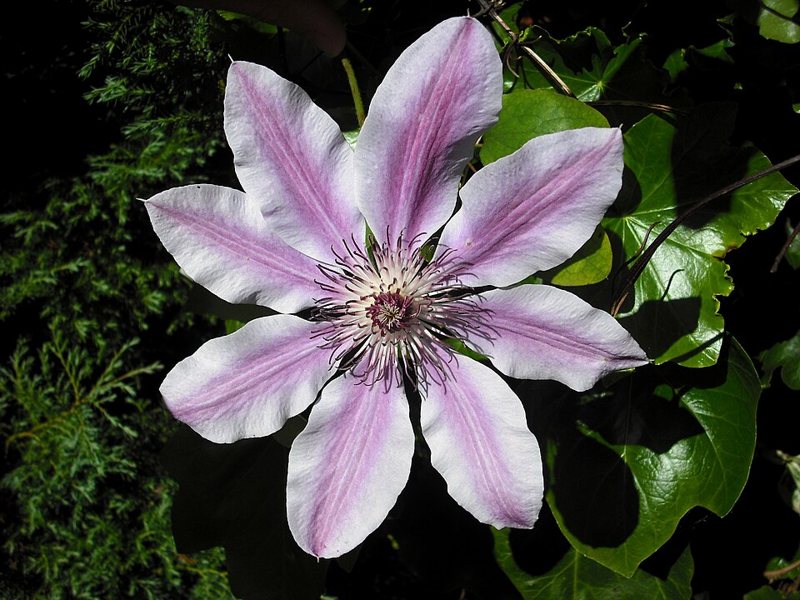
Jolly Janner · Public domain · Photo source · shows: Clematis

Clematis spp.
Also known as: Virgin’s Bower, Leatherflower
Family: Ranunculaceae · ASPCA plant record
Verdict at a glance
Evidence by animal
| Animal | Verdict | Basis | Plant parts | Sources | Evidence link |
|---|---|---|---|---|---|
| Companion mammals | |||||
| Cats | Cats: ⚠ Toxic | Not specified | ASPCA Toxic and Non-Toxic Plants Poison control | evidence | |
| Dogs | Dogs: ⚠ Toxic | Not specified | ASPCA Toxic and Non-Toxic Plants Poison control | evidence | |
| Horses & livestock | |||||
| Horses | Horses: ⚠ Toxic | Not specified | ASPCA Toxic and Non-Toxic Plants Poison control | evidence | |
| Small mammals | |||||
| Rabbits | Rabbits: ! Caution | WHRS Class 2: local or weaker toxin | Not specified | Wisconsin House Rabbit Society Rescue/education group | evidence |
| Birds | |||||
| Pet birds (general) | Pet birds (general): ⚠ Toxic | VCA: specifically reported harmful in birds | Not specified | VCA Animal Hospitals Veterinary reference | evidence |
| Budgerigars (budgies) | Budgerigars (budgies): ⚠ Toxic | Peer-reviewed experiment (PMID 1577644) | fresh plant material (powdered) | evidence | |
Source excerpts
ASPCA Toxic and Non-Toxic Plants — Cats, Dogs, Horses
poison-control
Toxic to Dogs, Toxic to Cats, Toxic to Horses
Source checked 2026-10-27
Read original sourceWisconsin House Rabbit Society — Classes of Toxic Plants — Rabbits
rescue-education
WHRS Class 2: local or weaker toxin · Wisconsin House Rabbit Society chapter list (G. Flentke, 2012): Class 2 — "Local toxins": "Allergens, dermal sensitivity toxins, or systemic toxins of lesser strengths" (list heading: "May cause allergic reaction in rabbits. Be cautious."). WHRS adds that, because rabbits inevitably chew items, these toxins "could be more of a problem than the current literature indicates".
Clematis
Source checked 2026-10-27
Read original sourceVCA Animal Hospitals — Plants That Are Toxic to Birds — Pet birds (general)
veterinary-reference
VCA: specifically reported harmful in birds · VCA: asterisk = "plants that are specifically reported to be harmful in birds".
Clematis*
Source checked 2026-10-27 (source updated Aug 14, 2026)
Read original sourceAvian toxicoses: a review (Frontiers in Veterinary Science, 2025) — Budgerigars (budgies)
peer-reviewed
Table 2, "Some plants are toxic to pet birds" (C = clinical report, E = experimental). Basis: experimental.
Clematis | Budgerigars (E)
Source checked 2026-10-27
Read original sourceEvaluation of selected plants for acute toxicosis in budgerigars — Budgerigars (budgies)
peer-reviewed
Peer-reviewed experiment (PMID 1577644) · fresh plant material (powdered) · Pairs of budgerigars were given powdered fresh plant material by gavage; of 19 plants tested only 6 induced clinical signs of illness. The abstract does not name the other 13 plants, so it supports no safe/non-toxic claim for any plant. The abstract says Clematis sp (species not named); the ASPCA entry is also genus-level (Clematis spp.).
Of the 19 plants tested, only 6 induced clinical signs of illness; these plants included yew, oleander, clematis, avocado, black locust, and Virginia creeper (Taxus media, Nerium oleander, Clematis sp, Persea americana, Robinia pseudoacacia, Parthenocissus quinquefolio).
Source checked 2026-10-27
Read original sourceNo evidence collected in this database yet for 17 animals
No evidence collected in this database yet for: Guinea pigs, Hamsters, Rats, Mice, Chinchillas, Ferrets, Parrots (macaws, Amazons, African greys…), Cockatiels, Lovebirds, Canaries, Finches, Pigeons & doves, Tortoises, Bearded dragons, Iguanas, Goats, Chickens & other poultry
No supported claim has been collected for these animals. Not listed does not mean safe; do not infer suitability from another species.
Toxic principles
ASPCA, as published: Irritant glycoside (Protoanemonin) Source
Clinical signs
ASPCA, as published: Salivation, vomiting, diarrhea. Source
Last verified (ASPCA record): 2026-10-27. Source access dates and limitations.
Similar plants (same family)
Shared family is not a shared verdict. Check each plant separately.